
How Barren County mourned President Kennedy’s assassination
Nearly a week after JFK’s assassination, a Barren County newspaper captured a community in mourning, from canceled school days to a courthouse memorial that brought residents together.
GLASGOW, Ky. — Schools closed, community events were canceled and residents gathered at the Barren County Courthouse as Glasgow and surrounding communities joined the nation in mourning President John F. Kennedy following his assassination in November 1963.
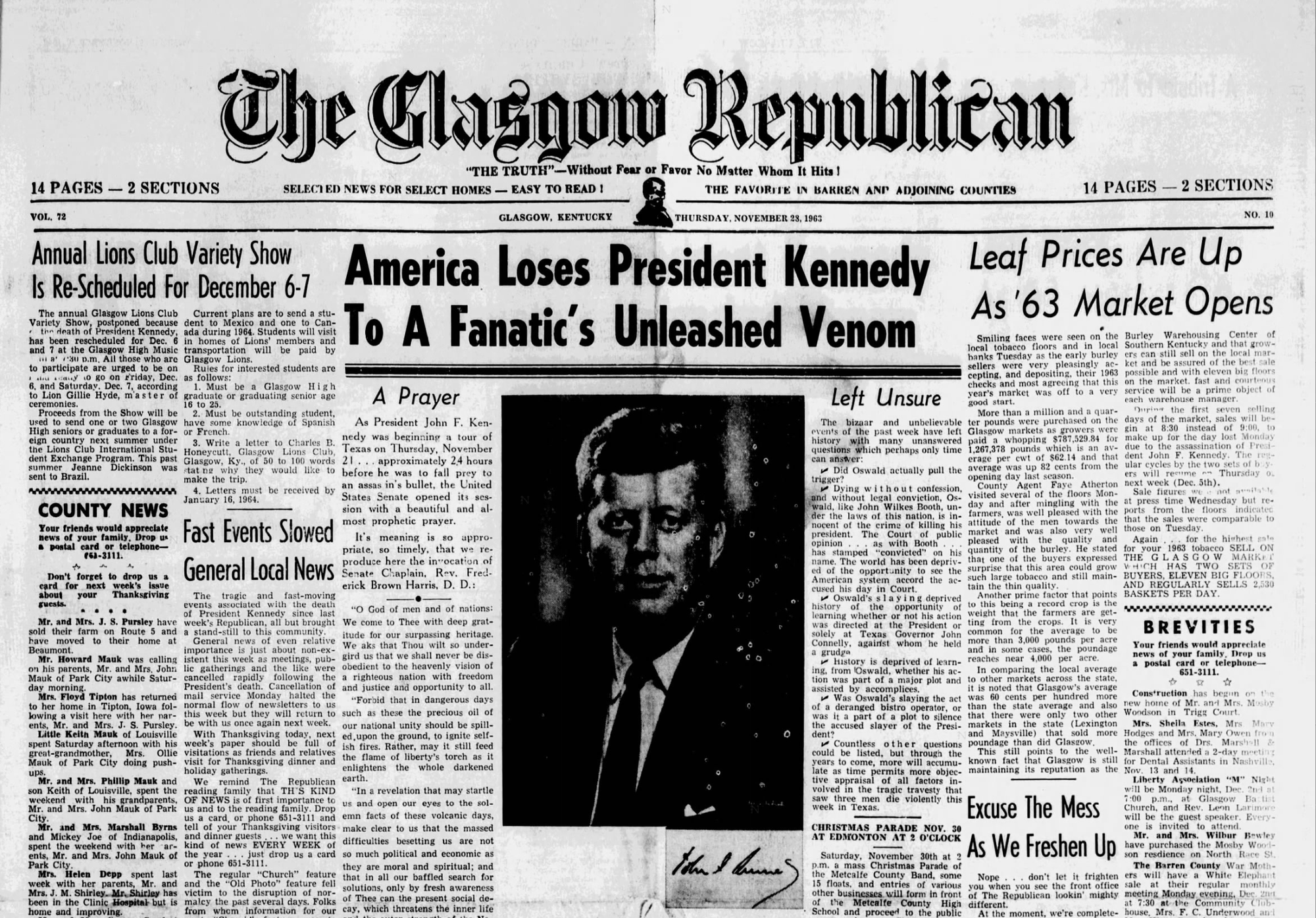
Nearly a week after Kennedy was killed Friday, Nov. 22, The Glasgow Republican devoted much of its Nov. 28 Thanksgiving edition to the tragedy and its aftermath.
The newspaper’s coverage carried the headline: ‘America Loses President Kennedy To A Fanatic’s Unleashed Venom.’
Published weekly on Thursdays, The Glasgow Republican’s Thanksgiving issue was its first edition since the assassination, offering local readers an account of the events that had shaken the nation and the response across their own communities.
“The traffic and fast-moving events associated with the death of President Kennedy since last week’s Republican, all but brought a stand-still to this community,” the newspaper reported.
Meetings and public gatherings were quickly canceled, while the suspension of mail service Monday disrupted the newspaper’s usual flow of correspondence.
Schools throughout Glasgow and Barren County also dismissed classes following the president’s death, according to Rebecca Dockrey, who contributed a community dispatch from Park City. A basketball game between Park City and Austin-Tracy was postponed indefinitely.
At Glasgow High School, the halls were unusually quiet that Monday.
“When the news of the President’s death reached our school on Friday, grief and sorrow filled the heart of each student,” wrote Martha Neal Nuckols.
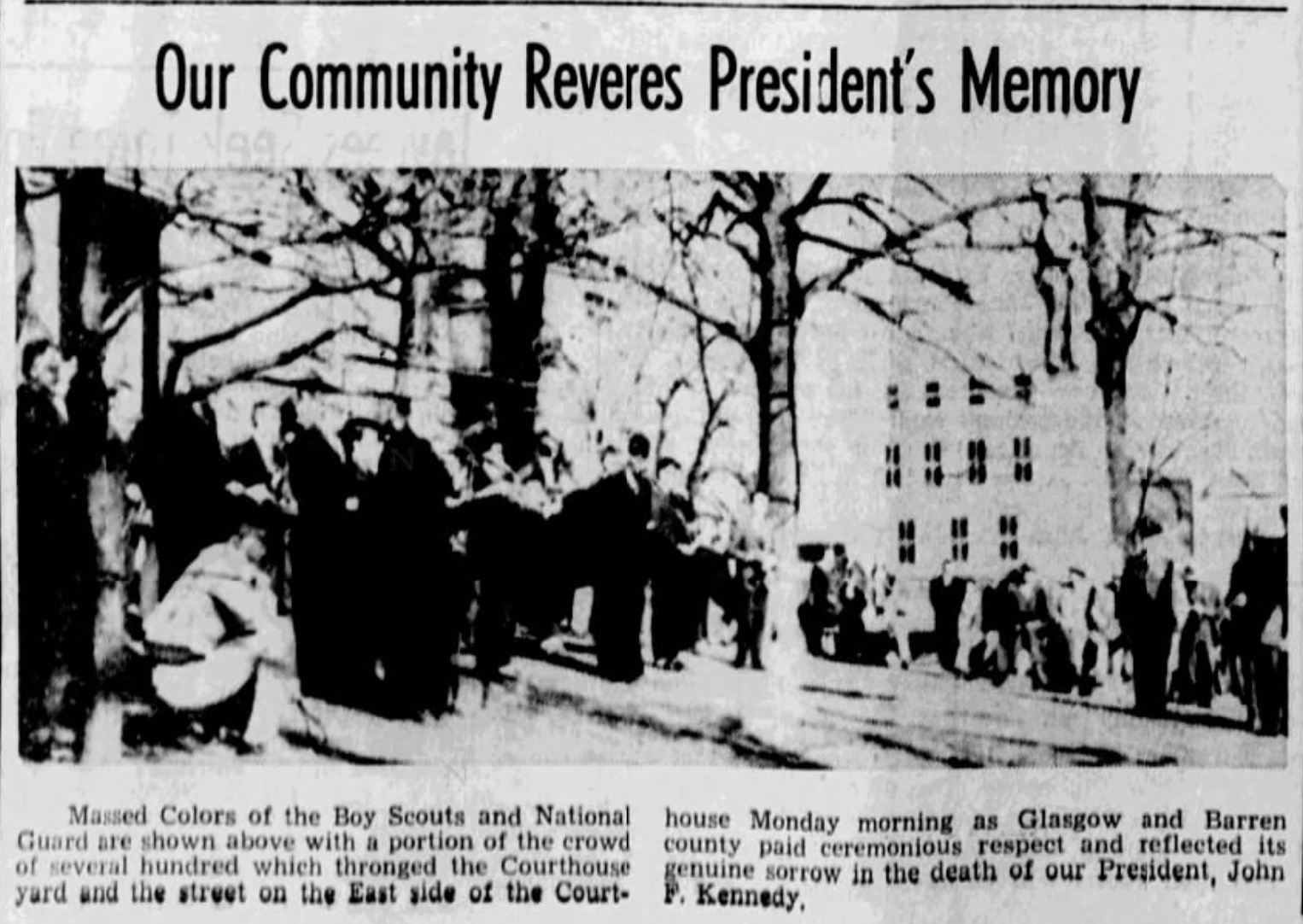
The community’s mourning was especially visible Monday morning, Nov. 25, when residents gathered at the Barren County Courthouse for a memorial service honoring Kennedy.
Members of the Glasgow High School marching band led a procession to the courthouse yard. Their drums were shrouded in black and muffled as a tribute to the fallen president.
A large crowd attended the service, which was presided over by Barren County Judge James E. Gillenwater, who arranged the gathering with assistance from Walter D. Aspley.
The Kentucky National Guard provided an honor and color guard, along with a firing squad. Local Boy Scouts furnished their colors, while representatives of the War Mothers, American Legion, Veterans of Foreign Wars, Disabled American Veterans and city and county government also participated.
The Rev. John Gorrone of St. Helen’s Catholic Church in Glasgow offered the invocation. Dr. C.C. Howard delivered remarks honoring Kennedy and drew a comparison to President Abraham Lincoln, who also was assassinated.
“Let us pray that the assassination of these two great presidents (Lincoln and Kennedy) may awaken in all of us, the spirit of being to all mankind a ‘Good Neighbor’,” Howard said.
A National Guard firing squad then fired a salute, followed by the sounding of taps. The Rev. Paul C. Duncan, pastor of Glasgow’s First Christian Church, delivered the benediction and offered a prayer for the new president, Lyndon B. Johnson.
The grief extended beyond Glasgow and Barren County.
In nearby Metcalfe County, Carol Sullivan described a community struggling to make sense of the tragedy, writing that there was a “steady flow of activities but all seemed to be worthless” following news of the assassination.
“How could it be that in America such a thing could happen? There is too much hatred in the world and what can we do about it? We can do nothing but the best we can.”
Sullivan also noted that churches throughout Metcalfe County held numerous worship services as residents mourned alongside neighboring communities.
Other student correspondents captured the shock felt in Hiseville and Temple Hill.
Sharon Sharpe recalled the moment students at Hiseville learned of Kennedy’s death.
“Everyone at Hiseville was shocked when our principal announced over the public address system Friday, that our thirty-fifth president, John F. Kennedy, had been shot and was dead,” Sharpe wrote.
The impact reached Barren Countians attending college, too. Diane Nuckols reported in her Campus Coed column, titled “Barren Countians at Western,” that classes at Western Kentucky University were dismissed Monday because of the president’s death.
The assassination also prompted changes to Glasgow’s regular activities. The annual Glasgow Lions Club Variety Show was postponed.
Another visible reminder of the community’s mourning stood in the Barren County Courthouse yard, where the American flag flew at half-staff.
The Glasgow Republican described the flag as being “on high but wavering, and as though head-hanging in dejection,” after it was lowered in tribute to Kennedy.
The flag held a special connection to the late president. It had been given to Barren County just a few months earlier after having flown over the U.S. Capitol during Kennedy’s presidency.
The local memorial service coincided with a National Day of Mourning proclaimed by President Lyndon B. Johnson for Nov. 25, the day of Kennedy’s funeral.