
Guthrie says Mammoth Cave should have a voice if Cave City data center could affect the park
Congressman raises concerns about ratepayers and water while defending local control over data centers.

GLASGOW, Ky. — U.S. Rep. Brett Guthrie said local communities should decide whether data centers are built in their communities, while acknowledging that Mammoth Cave National Park should have a voice if a proposed Cave City project could affect the park.
Guthrie, who chairs the House Energy and Commerce Committee, said the federal government should not force communities to accept data centers or prevent them from doing so.
“I don’t want the federal government to say you have to take a data center, nor do I want the federal government to say you can’t take a data center,” Guthrie said.
His comments come as concerns continue over the proposed Cave Point Commerce Center, which would be located near the southern boundary of Mammoth Cave National Park.
The National Park Service has not publicly commented on the potential environmental impacts of the project, and no environmental studies or other information about those impacts have been made public.
Mammoth Cave’s role
Guthrie said he has previously been asked to involve Mammoth Cave National Park in economic development discussions surrounding Cave City, including the proposed data center.
He said the National Park Service should primarily focus on protecting the national park rather than approving economic development projects outside its boundaries.
“If I lived in Barren County, I would not want the National Park Service approving economic development in Barren County,” Guthrie said. “I just think that it might work in one project, but if you start getting the National Park Service approving, permitting things around it, you’re talking about a quagmire that could cause.”
But Guthrie said that does not mean the park should be excluded from discussions when a development could affect it.
“Obviously, water goes into the cave system, so we have to be careful with that because we want to preserve Mammoth Cave,” Guthrie said.
When asked whether the National Park Service should have input on the Cave City project, Guthrie said it should if the project could affect the cave system.
“Absolutely,” he said.
Barren County Judge/Executive Jamie Byrd was previously scheduled to meet with Mammoth Cave National Park Superintendent Barclay Trimble to discuss the proposed data center.
Byrd said she wanted to hear the park’s concerns as she worked to learn more about the project from its developers. The meeting was later canceled.
Byrd said Aug. 19 that it still had not been rescheduled.
Protecting ratepayers
Guthrie said one of his primary concerns with the rapid growth of artificial intelligence and data centers is the potential cost to existing utility customers.
“Our number one priority is making sure that local citizens don’t foot the bill for AI,” Guthrie said.
Guthrie pointed to the bipartisan Ratepayer Protection Act, which passed the House Energy and Commerce Committee unanimously July 21. The bill was forwarded to the full House after the 52-0 vote.
The legislation would seek to prevent existing ratepayers from bearing the costs of new generation and grid infrastructure needed to serve large data centers.

Guthrie said electricity demand from AI is growing quickly and that the technology is moving into communities that have not traditionally housed such large industrial operations.
He said he does not support a nationwide or statewide moratorium on data centers.
“I don’t think there should be statewide moratoriums and certainly not a federal moratorium,” Guthrie said. “Because there are places you can put these. If we don’t, China’s going to.”
Guthrie said the United States needs to remain competitive in artificial intelligence and does not want China to control the technology and information infrastructure surrounding it.
Water use also a concern
Guthrie also pointed to water use associated with data centers.
During a recent visit to Glasgow, he toured Tate, a company that manufactures manifolds used in liquid-cooling systems for data centers.
“The water usage isn’t what the original data centers were,” Guthrie said. “A lot of people are trying to address these issues.”
He said newer cooling technologies, including closed-loop systems that recycle water within the cooling system, can reduce the amount of water needed to operate some data centers.
Water use could be a particularly important issue in Cave City because of the area’s karst geology and connection to the Mammoth Cave system.
Guthrie said he would need more information about the proposed project’s water use and discharge before determining whether it would be appropriate for the location.
 Brennan Crain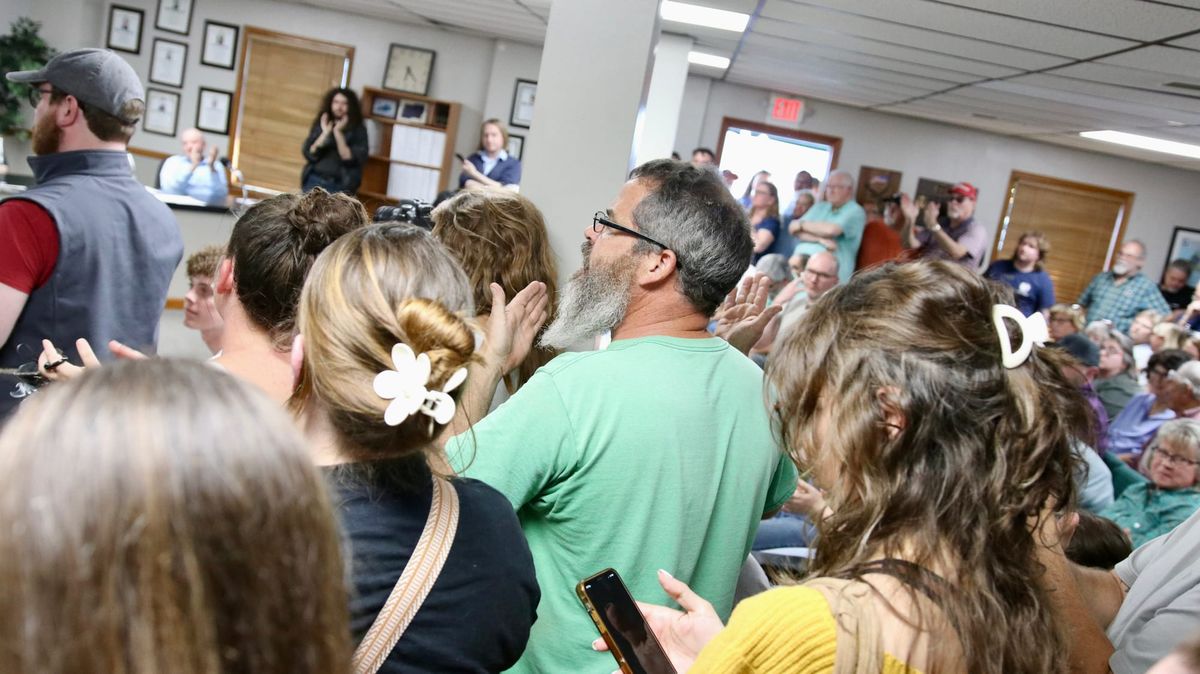
When asked whether Cave City is an ideal location for a data center, Guthrie said he did not know. He questioned whether other industrial developments in the area would face the same level of scrutiny.
“What if another Donnelley’s wanted to come back and build in that area, and then people have an opportunity to work?” Guthrie said.
Guthrie said concerns about data centers are legitimate because of the scale of the developments.
“Anytime you’re going to bring a massive facility into a community, it’s going to change a community,” Guthrie said.
Ultimately, Guthrie said those decisions should be made locally.
“I think communities should be able to set up zoning and be able to choose what they want,” Guthrie said. “I think if communities choose not to have a data center, that’s the choice they need to make.”
The proposed Cave City project is also the subject of ongoing litigation over the city’s moratorium on data center development. A developer has challenged the moratorium in court.