
Proposed tourism split hinges on Cave City ag expo center plan
Byrd said separating the county from the existing commission is necessary to generate additional revenue for new tourism facilities and events.
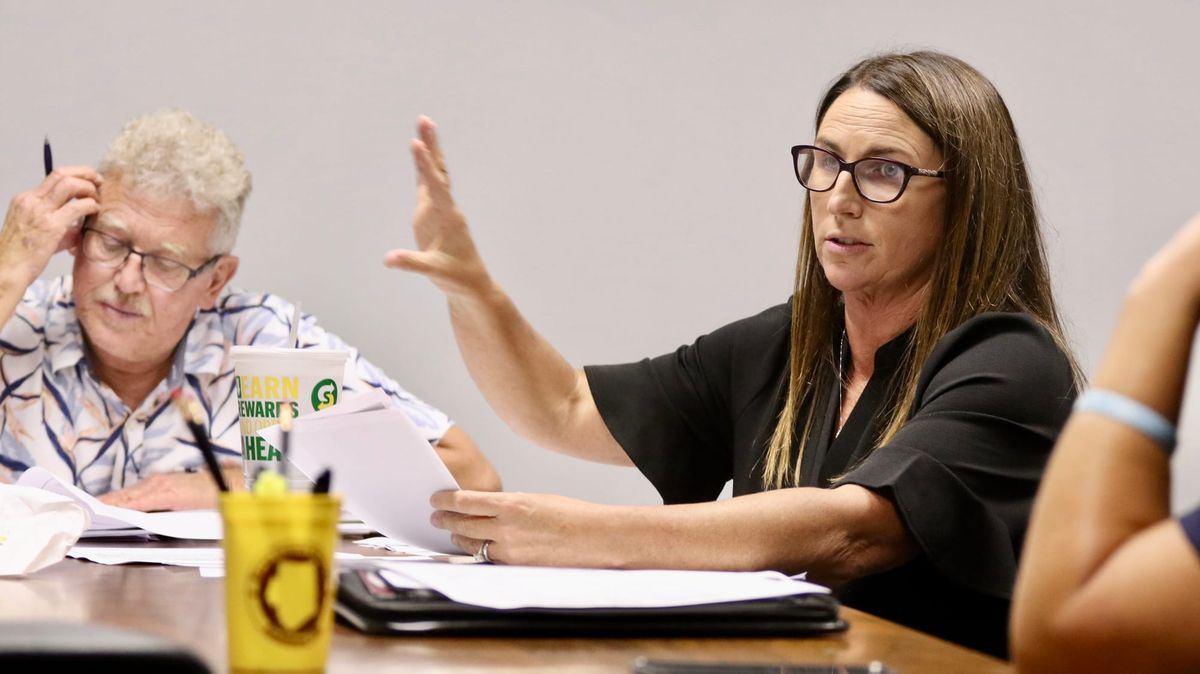
GLASGOW, Ky. — A proposed overhaul of Barren County’s tourism structure took center stage Tuesday at a committee meeting as Judge/Executive Jamie Byrd defended a plan for the county to withdraw from its joint tourism commission with Glasgow and create its own.
Glasgow and Barren County currently share a tourism commission, while Cave City and Park City have their own.
Byrd said creating a separate countywide commission would allow Barren County to generate additional lodging-tax revenue for tourism projects, including the proposed agricultural exposition center in Cave City.
Byrd emphasized the financial stakes of the proposal, saying the new revenue would be needed to operate the facility. Without it, she said, Cave City Tourism would be left to shoulder the ongoing costs.
“I’m just going to tell y’all, this is a make or break on the ag expo center,” Byrd said. “It is. We’ve got to have money to cover the expenses, the ongoing operations of the facility.”
Federal lawmakers have earmarked $20 million for the proposed “ag expo center.”
Byrd said the county cannot generate the additional lodging-tax revenue under its current arrangement. Barren County and Glasgow each currently levy a 3% lodging tax, with the revenue pooled into the same fund.
She said the county would need its own tourism commission to create the new revenue stream because each tourism commission is limited to a maximum 3% lodging tax. An additional 1% can be applied if there is a convention center.
“We cannot do it if we stay together—to create the other income,” Byrd said.
Byrd’s proposal would allow Barren County to establish its own 4% lodging tax countywide. The county tax would be separate from existing lodging taxes imposed by cities such as Glasgow, Cave City and Park City.
For example, a visitor staying in Cave City could pay the county’s 4% lodging tax in addition to Cave City’s existing 4% lodging tax.
Barren County currently collects about $135,000 annually in lodging-tax revenue from stays throughout the county, Byrd said. The revenue comes from lodging outside the cities, including Barren River Lake State Resort Park, Jellystone Park and short-term rentals such as Airbnb properties.
Byrd proposed phasing in the county tax over four years: 1% the first year, 2% the second, 3% the third and 4% the fourth.
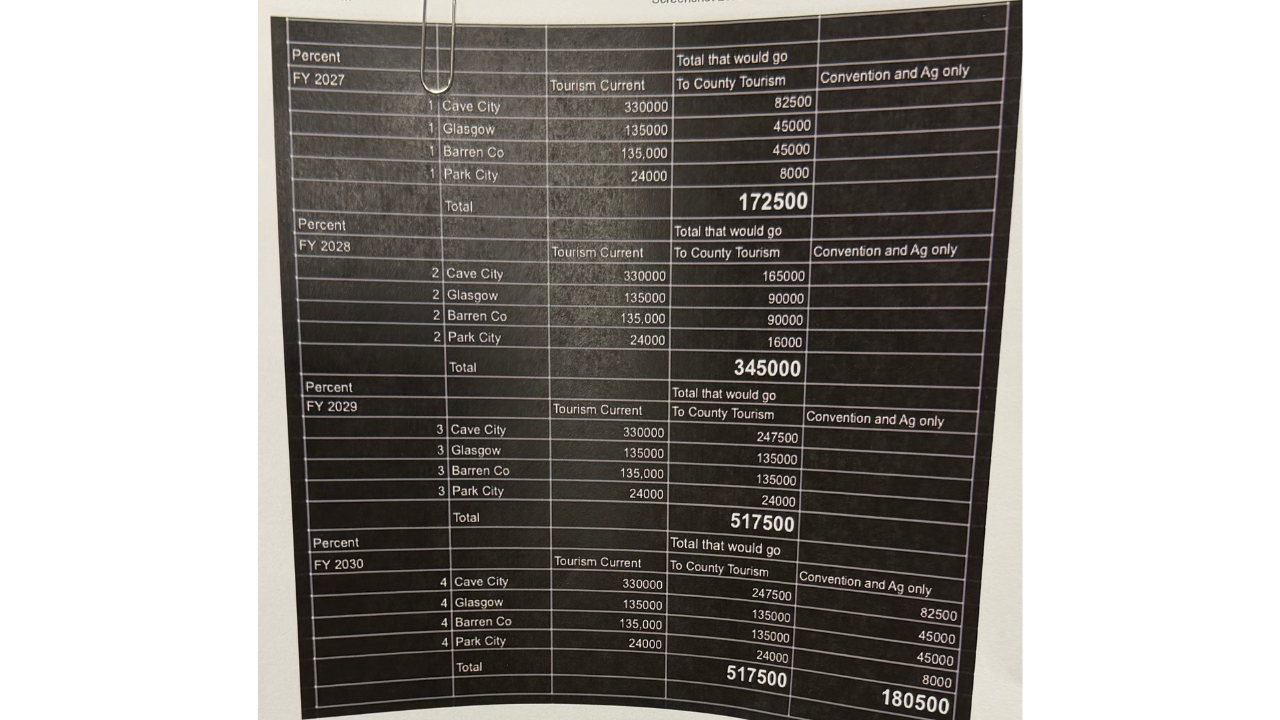
Based on projections presented by Byrd, the tax would generate about $172,500 annually at 1%, $345,000 at 2%, $517,500 at 3% and $698,000 at 4%.
Byrd said the county’s general fund would not be used to maintain the ag expo center. The fund is supported by property taxes and is already under strain from rising jail costs and reduced road funding following an earlier cut to the state gas tax.
She said the new tourism revenue would instead be used to support tourism-related facilities, events and operations.
Existing commission raises concerns
The Glasgow-Barren County Tourist & Convention Commission has opposed the split, formally asking Barren County to remain part of the joint agency.
The commission warned that losing the county as a partner would create “significant financial hardship” and could affect its ability to continue operating at its current level. Its proposed budget for the coming fiscal year projects $358,300 in revenue, including $300,000 from lodging taxes.
Byrd said she has tried to address those concerns and does not intend for the county’s withdrawal to undermine the existing commission.
In previous discussions with the commission, Byrd said she has reassured members that the new county tourism commission could absorb some costs currently paid by the joint commission, including dues to tourism-related organizations.
Byrd also said she wants to help the existing commission reduce its overhead by allowing it to move into the Barren County Government Center once the new justice center opens and county government operations move to the old courthouse across the street.
She said separating the county from the existing commission is necessary to generate additional revenue for new tourism facilities and events.
“You have to separate in order to increase any of these revenues,” she said. “We will justify every bit of these with the new facilities we have coming. Right now, we have no facilities that are built that hold the events that we will hold at these venues.”
Byrd also pointed to the proposed sports complex in Glasgow, planned for a portion of the Johnson Property purchased by the city in 2024.
She said the county’s lodging tax could generate revenue from visitors who travel to Glasgow for tournaments and other events at the complex and stay overnight anywhere in the county.
Byrd pushed back against criticism that four tourism commissions would be too many for one county, saying the separate commissions reflect the distinct tourism markets across Barren County.
If Barren County forms its own commission, it would join three others: Glasgow, Park City and Cave City that each levy their own lodging taxes.
No decisions made
Magistrate Marty Kinslow, who chairs the committee, called the issue the “elephant in the room” and said the “blunt” truth was that the ag expo center would not happen without a separate county tourism commission.
Kinslow said the federal government could redirect the $20 million if the county does not move forward.
“The government would be more than happy to take their $20 million back, and if they do, they’re just going to give it to somebody else,” Kinslow said.

No decisions were made Monday afternoon. Kinslow said county leaders need more time before deciding how to proceed.
“We’re going to have to do it or don’t, but I don’t believe today is that day. We need to make a decision. Sooner would be the better, but today’s not that day,” Kinslow said.
Byrd also addressed what she described as misinformation circulating online about the proposal, saying her goal is to prepare Barren County for future growth rather than dismantle an existing system.
If the county creates its own commission, Byrd said she intends to ensure Glasgow’s tourism operations can continue.
She said she also does not intend for the restructuring to cost anyone their job.
“I want to work with people. I think we could do a really good thing, and that’s the way we went about it,” Byrd said. “But the whole agenda that’s being pushed—that somebody’s losing their job, that’s not true.”
Byrd said the proposal is not about taking money away from existing tourism efforts, but creating additional revenue.
“All of the people that say it’s a money grab, there’s not money to grab,” Byrd said. “These people are still going to get their money. These are more monies that we can bring in for tourism-type events.”
Byrd said the proposal is ultimately about preparing for Barren County’s long-term tourism growth.
“All I’m trying to do is what’s best for long-term Barren County,” she said. “This is not about a one-year thing, and this is not saying that anybody’s not doing a good job. This is what other communities have done to bring in more.”