Barren County dispatcher works through cancer while answering 911 calls
For April Lanning, the call to become a telecommunicator came about three years ago, when a local deputy urged her to apply for a position. She had been working in the restaurant industry.
GLASGOW, Ky. — Whether it’s a flat tire on the roadside, a child in distress, or a call to check on a loved one, dispatchers are the first to answer.
The Barren-Metcalfe Emergency Communications Center handles every 911 call across both counties, and often beyond, working to make sure help reaches those who need it most.
For April Lanning, the call to become a telecommunicator came about three years ago, when a local deputy urged her to apply for a position. She had been working in the restaurant industry.
“I never thought I'd be into it,” Lanning said. “Three years later, and I love it.”
Currently, there are 11 full-time dispatchers in Barren County and three part-time, according to the Barren-Metcalfe Emergency Communications Center website.
Every day brings something different.
“It's chaos,” she said.
But within that chaos, there is structure — seconds matter, and organization becomes the difference between confusion and coordinated response.
“It takes a special person to be in here and doing it,” Lanning said. “You got to be able to multi-task and you can't be soft.”
The day in the life
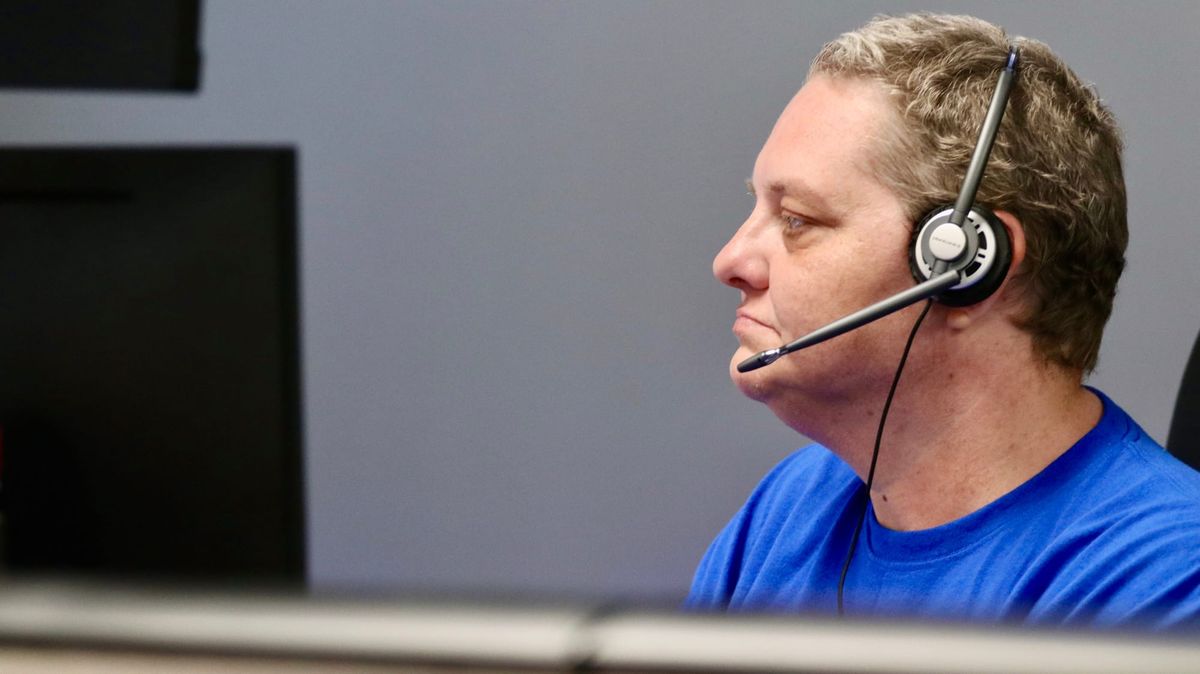
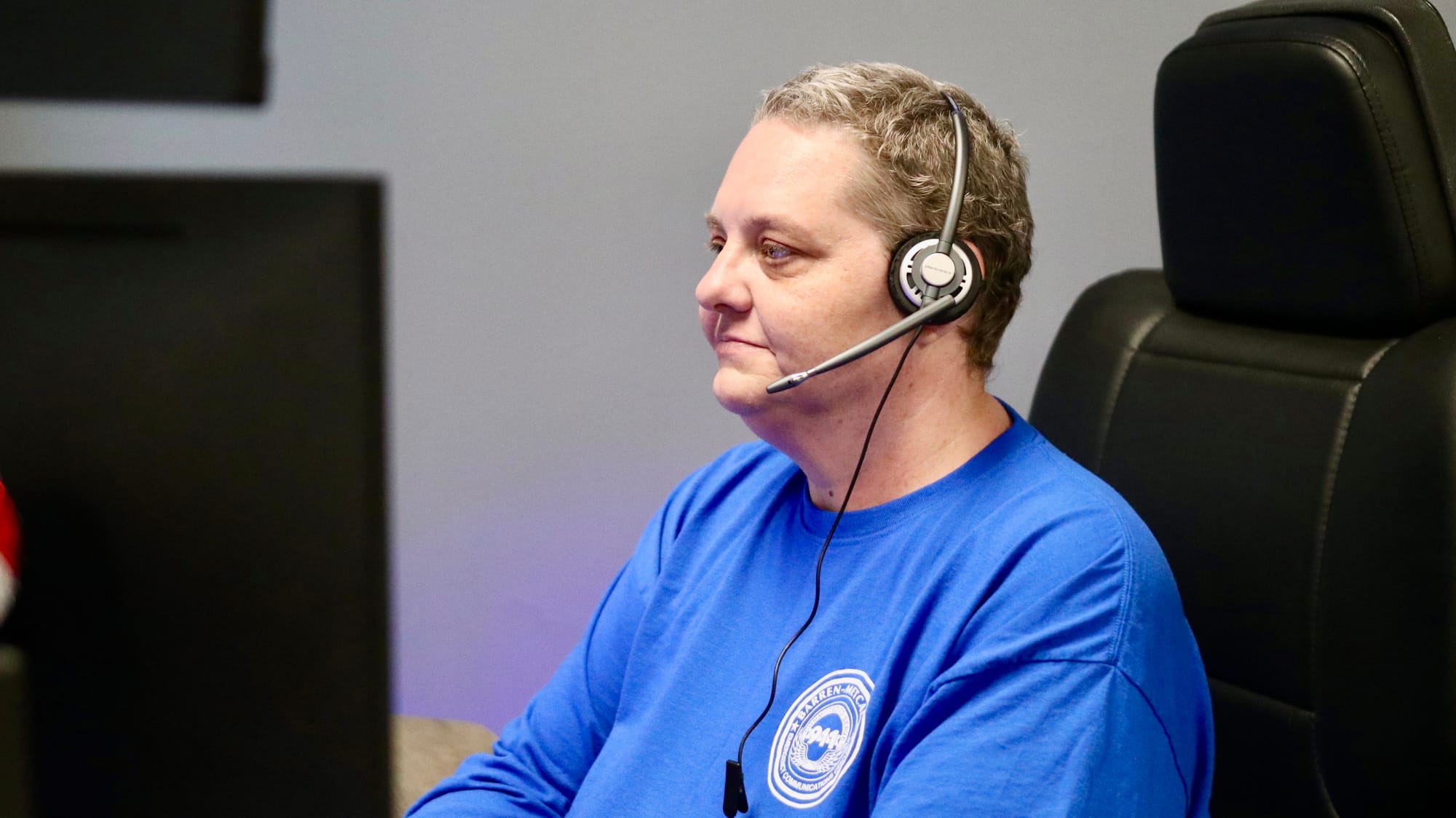
As she takes her seat, she slips on the headset, logs in to her computer, and waits for the phone to ring.
A panel of six screens glows in front of her, layered with maps, caller data and live updates, every piece of information she might need when the next voice comes through the line.
It can feel overwhelming, but the mark of a skilled dispatcher is the ability to manage it all at once and develop a sharp “radio ear.”
“You are having to listen to multiple conversations at the same time. That's kind of difficult. You have to get that radio ear,” Lanning said. “It took me a while to do that.”
A tight cluster of four dispatch stations fills the communications center, tucked at the corner of East Washington and Broadway streets.
Inside, dispatchers rotate across three primary responsibilities—police, fire or EMS—though in reality, everyone works together to handle whatever comes in.
A screen flashes red with “911” in bold type as a distinct ringtone cuts through the room. A different tone follows when a call comes in on the non-emergency line.
Every call that comes into the center is assigned its own CAD, a computer-aided dispatch entry that tracks details, timestamps and updates from the first ring to the final report.
Those CAD reports appear across every monitor in the dispatch center, allowing one telecommunicator to gather information from a caller while another is already sending crews to the scene.
The dispatch lines are organized on a single screen, each just a tap away to switch between them. As a caller continues describing the scene, the dispatcher can briefly place the line on mute to begin alerting and dispatching the appropriate crews.
“We can jump wherever we need to jump,” Lanning said.
The first to answer, the last to know
While police, fire and EMS crews are often considered first responders, dispatchers are the ones who answer first.
From the moment they pick up the phone, they’re gathering critical information and relaying it to crews in the field, and even after that first transmission, their role continues as they monitor, update and guide the response in real time.
“It takes a special person to be in here and doing it,” Lanning said. “You got to be able to multi-task and you can't be soft.”
At times, crews arrive on scene and dispatchers never learn how the situation turned out. Those unanswered calls can leave a lingering sense of void, something dispatchers say they eventually have to learn to live with.
An emotional toll
Some calls make the news while others never do, but all of them carry a toll.
Over the last six months, dispatchers have handled a series of tragedies in Barren County, including a triple-fatality crash that claimed the lives of three teenagers, the murder of a young mother and her unborn child, additional fatal wrecks, countless medical calls, devastating house fires and more.
Lanning said she remembers one of the first calls of her career involved a child who called for help after being sexually assaulted.
“The first call was rough. It really bothered me,” she said. “But I held it all together while on the phone. Afterward, I had to go take a break.”
Lanning, a mother of two, said she often feels her “motherly instincts” kick in while she’s on the phone. Still, some moments linger and are harder to forget than others.
An employee assistance program gives city dispatchers access to therapists and mental health professionals when they need support. They also lean on each other.
“It's like a big ole family,” she said. “These are some awesome people that I work with, and I couldn't ask for better coworkers. That's one thing that keeps me coming back here every day.”
Beyond the call
Lanning has two children, both now grown. But she said life hasn’t necessarily gotten easier, noting that her son is currently battling brain cancer.
In the midst of her son’s cancer journey, Lanning began noticing that food felt like it was getting stuck when she ate. After a series of tests, doctors diagnosed her with esophageal cancer.
She wears a chemotherapy pump, which she points out as she sits at her dispatch station. After four rounds of chemotherapy and surgery last week, she is now in her fifth round, with three more still ahead.
“It’s been a struggle to actually stay,” Lanning said. “But it helped me push through both mentally and physically cope with what I’m dealing with at home.”
Her nickname is Bulldog, a name that quickly makes sense given her resilience.
Between her personal battles and the demands of the job, she has become a steady presence in the center.
And for the record, she keeps it professional on the radio. She doesn’t recall ever being called Bulldog while dispatching, but she wouldn’t be surprised if it sticks one day.
A few curveballs along the way
There’s one piece of information everyone should provide when they call 911: location. Lanning said operators ask where the emergency is before they ask what it is so help can be sent immediately.
Cell tower signals and phone GPS data often help dispatchers pinpoint a caller’s location before they even speak it aloud.
In other cases, calls from outside the immediate area still route through due to how interconnected 911 systems are designed, ensuring calls are always answered.
A recent caller from Texas was in the area and called 911 to notify police of a crime.
“He had notifications that he had people breaking into his home, so he called 911,” Lanning said. “It came directly here.”
Because the call initially routed through locally, Lanning had to determine where it truly belonged. She located the appropriate agency for the caller’s address and connected him to them.
Other times, interstate traffic along major highways routes calls into Barren County, which often requires a quick patch-through to Kentucky State Police.
There have also been instances where out-of-state 911 calls land locally before being redirected.
Spam calls occasionally make their way in as well, Lanning said.
A lifelong dedication
Between emergency calls, routine reports, and everything in between, dispatchers wait for the next tone to break the silence.
For Lanning, it’s just another shift in a job she never expected to love, but now can’t quite imagine leaving.
“I'm hoping that I can get everything squared away at home with mine and my son's cancers and all of that,” she said. “I hope to retire out of here.”
National Public Safety Telecommunicators Week is observed annually during the second week of April. In 2026, it fell on April 12–18.