
Fighting for the ‘luxury’ of air in Kentucky’s worst region for pollution
The 2026 “State of the Air” report from the American Lung Association shows 176,359 children in Kentucky breathe air with unhealthy levels of pollution.
For Louisville high school math teacher Lindsay Thurman, air quality isn’t an abstract concept; her body tenses and cramps as she fights through pollutants to breathe.
Thurman lives with the rare pulmonary arterial hypertension (PAH), which features “abnormally high” blood pressure in lung arteries, according to the National Organization for Rare Disorders.
“It just seems as though my lungs were kind of built wrong, and the blood vessels in my lungs constrict and thicken, which makes it harder for my heart to push blood into my lungs to pick up oxygen, which makes the heart larger, which makes it harder to breathe,” Thurman explained. “It’s just a mess.”
To boot, she breathes some of the worst air in Kentucky, according to a report released Wednesday.
The 2026 “State of the Air” report from the American Lung Association shows 176,359 children in Kentucky breathe air with unhealthy levels of pollution.
According to the report, the Jefferson County area — the report includes Clarksville, Indiana, and down to Elizabethtown as part of this area — is one of the dirtiest in the United States for ozone smog. Reasons for this include engine exhaust, factory output and wildfire smoke as pollution drifts in and settles in the Ohio Valley. Louisville is the most populous city in Kentucky.
This annual report issues grades to cities based on air quality. The Louisville area received an F for ozone smog and year-round particle pollution because it has nearly 11 days every year labeled unhealthy. The area has received a failing grade for years.
Meanwhile, several Eastern Kentucky counties ranked among the cleanest in the country for ozone smog.
Findings in the report
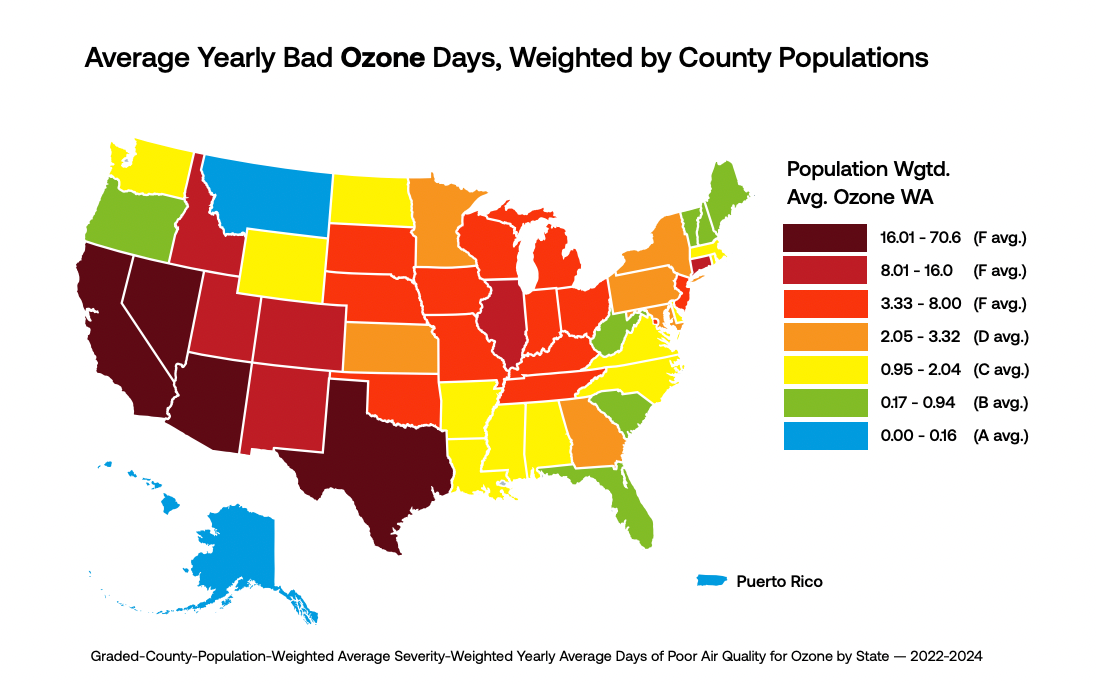
Rural Kentucky earned a few wins in the latest State of the Air Report, but the state overall continues to rank poorly for air quality.
Findings in the report include:
- Eight Kentucky counties continued to be listed among the cleanest in the country for ozone smog — Bell, Boyd, Carter, Greenup, Morgan, Perry, Pike and Pulaski. They all earned an A grade in the report based on their low levels of ozone.
- Perry County was the worst in the state for the daily (short-term) measure of particle pollution, earning a D grade.
- Jefferson County posted the worst value for ozone smog in Kentucky, earning the Commonwealth’s only F grade, and driving the Louisville metro rank from 29th worst to 22nd worst in the nation.
- Jefferson County was also worst for the year-round measure of fine particles, but improved enough so that now all Kentucky counties graded for this measure earned passing marks.
In many ways, the trends in the report aren’t surprising to Shannon Baker, the advocacy director for the Lung Association in Kentucky.
“Our grades tend to be worse in more urban areas and, of course, better in more rural areas, which probably makes sense intuitively, because these are areas — the urban areas that is — are areas with greater population density and typically, therefore greater numbers of emission sources,” she said. “Louisville really sort of ranks the worst in the state by most measures, struggling continuously with ozone smog, which has this year and landed us among the dirtiest 25 cities in the U.S.”
Air pollution can also trigger asthma, which makes breathing more difficult. About 12% of Kentucky adults and nearly 7% of children overall have asthma, according to the Cabinet for Health and Family Services.
Pockets of the state like Louisville, where the air is worse, have higher rates of asthma, said Dr. Scott G. Bickel, a pediatric pulmonologist with Norton Children’s.
“It’s multifactorial in nature,” Bickel told the Lantern. “But certainly when you overlay a map of areas with higher prevalences of asthma, they go along with areas that have higher levels of air pollution (and) less, say, green space.”
Asthma can be “quite serious,” Bickel said. It’s one of the main reasons kids end up in the emergency room. The incurable but manageable condition can also keep children from playing sports and out of the classroom in a state already struggling with high rates of absenteeism.
He described asthma like this: “Think about the airways kind of like an upside down tree. You’ve got the trachea, or the windpipe; that’s the main airway, and then you’ve got multiple generations branching into tiny, tiny airways. And these airways have smooth muscle around them, and when they get inflamed, or something irritates them, they clamp down and so then, it’s very hard to get a breath in and very hard to get a breath out. And so you’ll oftentimes hear people with asthma describe their breathing as ‘it’s very tight, it’s hard to get air in and out.’”
Treatments like inhalers, when used correctly, can help manage the symptoms of asthma, Bickel said. Inhaling steroids can “rapidly” open those airways and allow breath to flow more easily.
Poor air quality can also contribute to the severity of bronchiolitis, Bickel said, as well as chronic obstructive pulmonary disease (COPD) and heart disease.
“Dirty air is dangerous to public health. It causes people to suffer immediate and potentially fatal medical problems like heart attacks and strokes and asthma attacks,” Baker said. “In the long run, particle pollution can cause lung cancer and breathing unhealthy levels of ozone or particle pollution can shorten your life by months or even years.”
Data Centers and the EPA
In February, the Environmental Protection Agency (better known by its acronym EPA) ended the 2009 Greenhouse Gas Endangerment Finding, which Harvard University called “the basis of greenhouse gas regulation in the United States.” The EPA said it doesn’t have statutory authority to “prescribe standards” for greenhouse gas emissions and boasted the move would “save Americans over $1.3 trillion.”
The State of the Air report criticized this and other EPA decisions, saying “the impacts of these rollbacks will be felt in the form of increased air pollution, illness and death.”
READ ALSO: Louisville’s bad air days are on the rise as Trump’s cuts to EPA alarm public health advocates
It also means Kentucky and other states will lack key data around pollution and how it impacts health, Baker said.
“There is, as we all know, overwhelmingly clear evidence that the climate is changing and humans are responsible, and climate change is, in fact, a health emergency,” Baker said. “So air pollution data show warmer temperatures are increasing ozone levels and wildfires make more frequent and intense spikes in particle pollution, and this is backed up by experiences that people all across the country are having with more heat and more severe storms and more wildfire impact.”
The report also highlights data centers as increasing contributors to air pollution as they consume about 4% of the nation’s electricity and are expected to triple by 2028 thanks to the demands of artificial intelligence.
Kentucky doesn’t have any operational hyperscale data centers, though one is in the works and expected this fall in Louisville despite protest from locals.
“With the increase in demand and development of new data centers, ensuring the facilities are powered by clean electricity, and transitioning to clean power and storage resources instead of diesel, as an example, can play a role going forward in cleaner air,” Baker said.
The ‘luxury’ of air
Lindsay Thurman, a high school math teacher, lives with the rare pulmonary arterial hypertension (PAH), which makes breathing difficult. In 2021, she became the first known PAH patient to finish a marathon. (Photo provided)
Thurman’s PAH developed in her early 20s, but her breathing issues go way back. She had sports-induced asthma as a child and tried running cross country in middle school but had to stop because her wheezing “freaked” her mom out. She couldn’t get enough air into her lungs.
She still has a rescue inhaler but her asthma has greatly improved. Thanks to the series of drugs she takes every day — including one she takes once a day, one she takes every 12 hours and another she has to take every eight hours — Thurman has even been able to take up running again.
In 2021, she became the first known PAH patient to finish a marathon — and she did so in Louisville, crossing the finish line in under five and half hours.
Still, she has to monitor air quality notices daily. On bad days, she knows she can’t run as far as she’d like. On long runs, she brings a rescue inhaler. She practices yoga. Anything to keep her lungs as healthy as they can be.
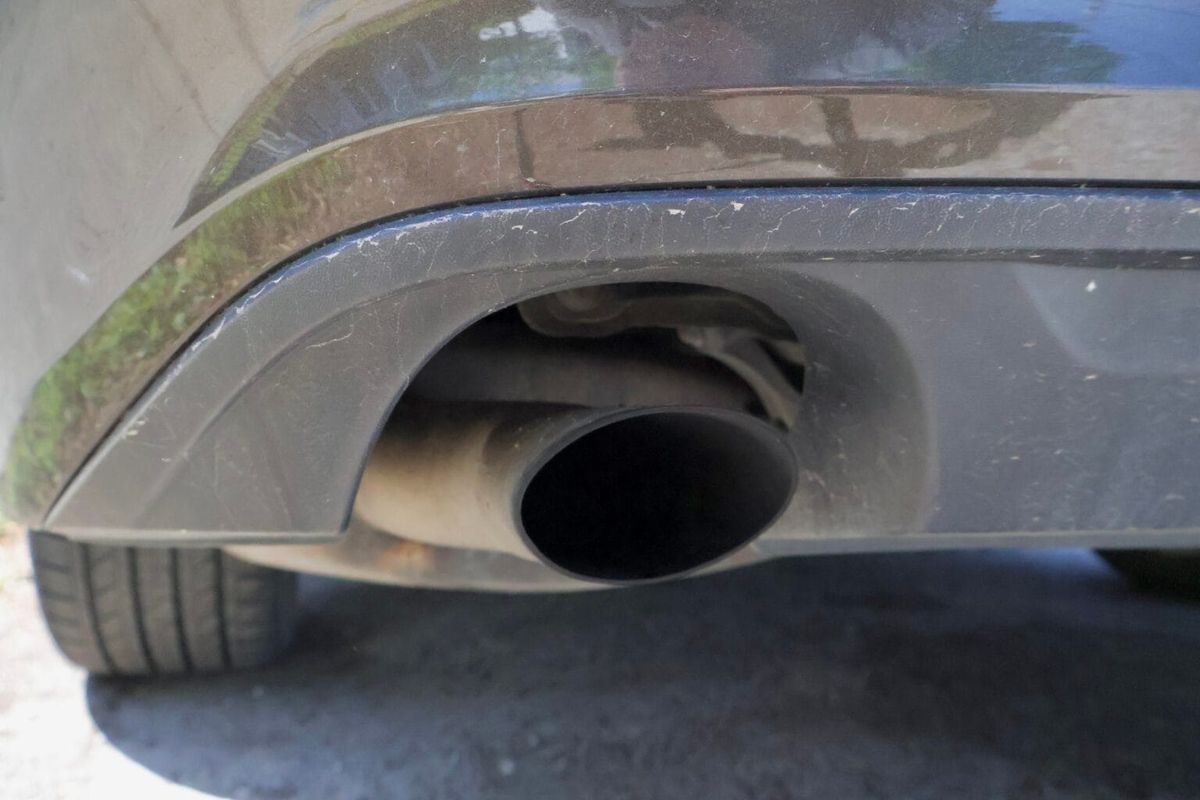
Despite the relative stability she enjoys on her current medication regime, she feels pollution in the air — like exhaust from a passing car — in her entire body.
“I love running through Cherokee Park. There are times where cars with really bad exhaust will drive by, and I can feel it in my lungs,” she said. “It’s not just that it smells. I can feel my lungs tense up.”
Not being able to breathe impacts more than just the lungs. She’s gone through spurts of being “constantly tired,” she said. Other times, “I was in different amounts of pain depending on how well my breathing was.”
When she can’t get enough oxygen, she said, her body becomes desperate, cramping first “at the edges” and “working its way in” until her head is pounding and her vision “fuzzy.” On occasion, she’s even passed out.
“It can be extremely painful. Your body does not like not having oxygen. It doesn’t feel good. If anybody’s ever had a side ache from running, imagine that everywhere,” she said. “It is terrifying to have your body react in a way that it is doing that desperate, desperate sucking in of the air, but having it not actually help.”
There are also the moments she characterized as “embarrassing” — having to stop and catch her breath over seemingly “minimal” tasks like walking across a parking lot or walking up two steps.
She wants people to know that “when the air is really bad quality, it might be bad enough that people without lung lung conditions can even tell a difference,” she said. “But living with a lung condition is already so hard, and so air is like this luxury that you don’t feel like you ever really get when you can’t breathe well.”
Ways to contribute to cleaner air
Several organizations and agencies recommend actions that can help make air cleaner. They include:
- Burn less coal.
- Drive less when possible by running errands at once to reduce toxic exhaust. Carpool and ride bikes or public transportation when possible. When you drive, avoid idling.
- Turn off lights when not in use and, when possible, choose appliances with higher energy efficiency ratings.
- Don’t burn leaves or trash. Use leaves as compost.
And more.
Kentucky Lantern is part of States Newsroom, a nonprofit news network supported by grants and a coalition of donors as a 501c(3) public charity. Kentucky Lantern maintains editorial independence. Contact Editor Linda Blackford for questions: info@kentuckylantern.com.