Inside the plans for Barren County’s proposed data center
New details reveal how the proposed seven-building Barren County data center would operate, including its plans for electricity, water, cooling, environmental protections and site development.

What you need to know:
- The latest proposal calls for seven one-story data center buildings totaling approximately 1.4 million square feet in unincorporated Barren County, entirely outside Cave City limits.
- OTN Group says the campus would initially use on-site natural gas generators for power and a closed-loop, air-cooled system requiring an estimated 10,600 gallons of water per day.
- The proposal differs from an earlier 10-building concept outlined in a June economic impact report. An updated economic impact study is being prepared.
- The development comes as Barren County works to establish its first comprehensive zoning ordinance. The Planning Commission has forwarded a proposal to magistrates, but the formal ordinances needed for consideration are still being prepared.
- Litigation involving Cave City’s data center moratorium and 2024 annexation remains ongoing, while a separate request to discontinue Hughes Road is scheduled for a Dec. 1 public hearing.
CAVE CITY, Ky. — A revised proposal for the Cave Point Commerce Center calls for seven one-story data center buildings totaling approximately 1.4 million square feet, with the entire campus planned for unincorporated Barren County outside Cave City’s municipal limits.
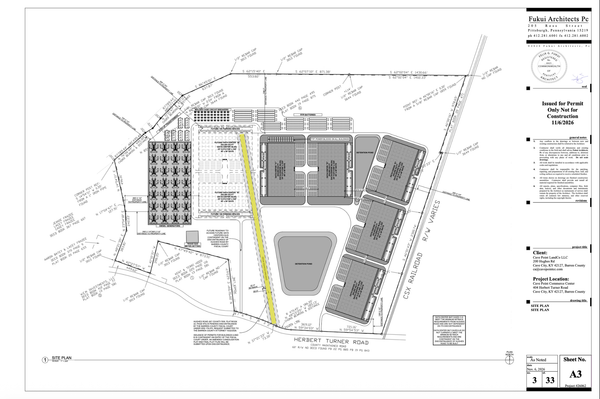
Each building would measure approximately 205,000 square feet, according to updated plans provided by OTN Group, which manages development of the project for Cave Point LandCo LLC.
Permits for six buildings were submitted in early November, with plans for the seventh submitted Nov. 9.
In response to questions from Barrenside, OTN provided additional details about the proposal’s electricity and water needs, cooling systems, environmental protections and utility arrangements.
The updated plans come as litigation involving Cave City’s data center construction moratorium and 2024 annexation continues.
Electricity and power
OTN said the development initially would rely on modular, natural gas-powered generators located on the property while awaiting permanent electric service through Farmers Rural Electric Cooperative Corporation and East Kentucky Power Cooperative.
The generators would produce electricity on-site and be housed in acoustical enclosures designed to reduce noise. OTN said they would use modern emissions controls and operate under applicable local, state and federal regulations.
The on-site generation is intended as a bridge to electricity supplied through the regional power grid. The project’s final power requirements and timeline for a grid connection have not been established.
 Brennan Crain

OTN said it is working with the utilities to finalize those requirements through engineering and a transmission study with East Kentucky Power Cooperative.
The study will help determine whether the existing electrical infrastructure can handle the project’s demand and whether improvements would be needed to deliver power to the site.
Any eventual grid connection would involve Farmers RECC and East Kentucky Power Cooperative under EKPC’s data center tariff, approved by the Kentucky Public Service Commission in October 2025.
The current proposal differs from the earlier concept outlined in a June economic impact report, which examined a 10-building campus totaling approximately 2 million square feet.
The June report estimated the earlier development could require as much as 1,200 megawatts of electricity. OTN said that figure reflected the earlier layout and that power requirements for the current proposal are still being finalized.
OTN said Commonwealth Economics of Lexington is preparing an updated economic impact study based on the current proposal. The company said the study will help explain the project’s potential contributions to the local tax base and schools.
OTN has not identified a potential data center operator or end user. The company said it is not able to discuss end users at this stage, which it described as typical for a project in this phase.
Water and cooling
OTN’s current request to Caveland Environmental Authority is for approximately 10,600 gallons of water per day for the entire campus. The utility has indicated it can accommodate the project’s water and wastewater needs.
The estimate includes water used to replenish the cooling system, along with domestic water for employees and daily operations.
The company said the buildings would use a closed-loop, air-cooled system, with no evaporative cooling, cooling towers or groundwater extraction for cooling.
A closed-loop system works much like an air conditioner in a home or vehicle, recirculating water through a sealed system to carry heat away from equipment without continually consuming new water through evaporation.
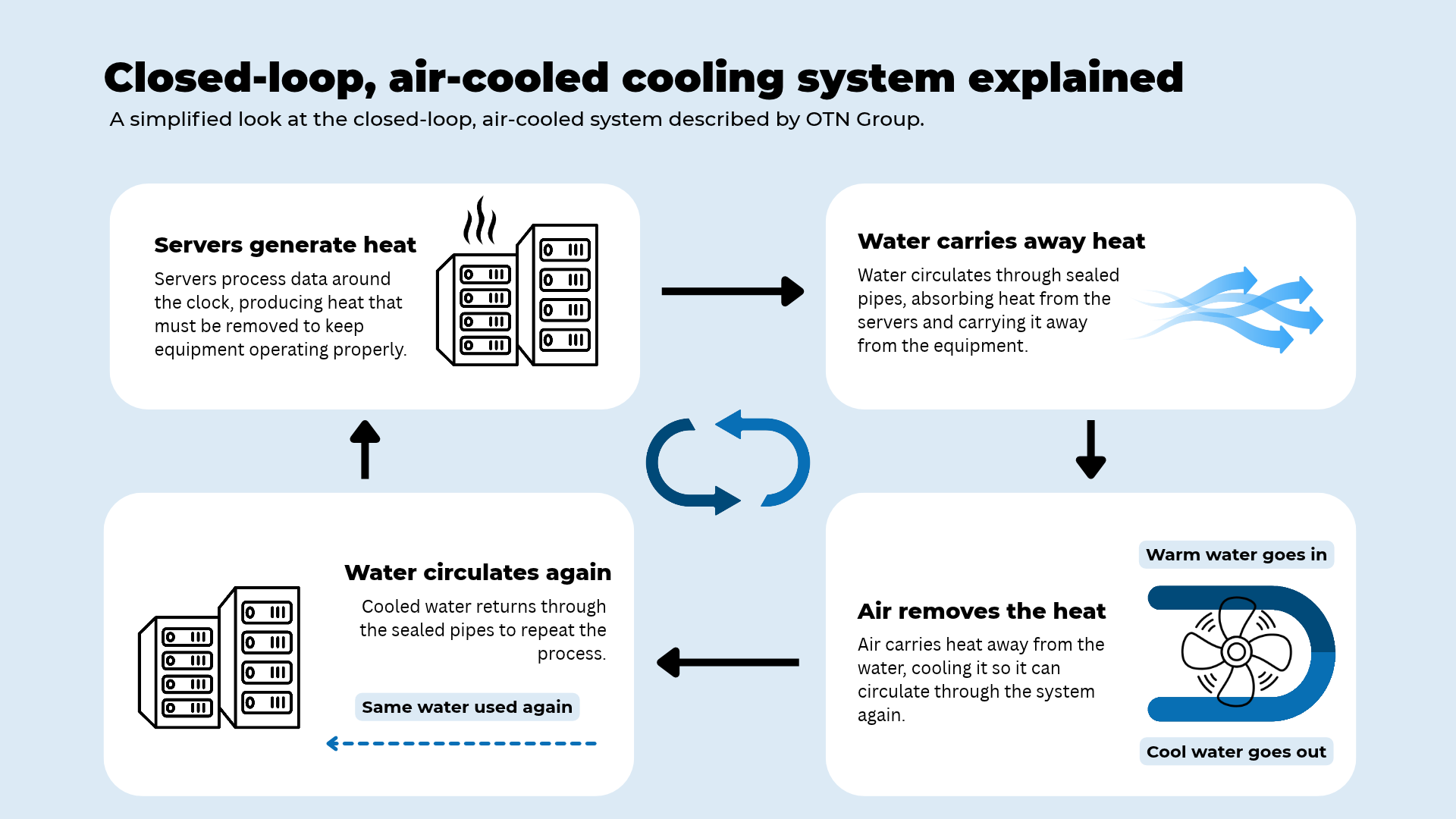
Although the system recirculates water, it still requires an initial supply. OTN estimates approximately 280,000 gallons would be needed to fill each building's cooling loop, or about 1.96 million gallons across the campus.
The current estimate differs considerably from the June economic impact report, which projected that the earlier, larger development could use approximately 300,000 gallons of water per day.
Caveland Environmental Authority CEO David Peterson told Barrenside that the higher June estimate was based on an open cooling system rather than the closed-loop system now proposed.
Peterson said the proposed data center’s daily water use would be comparable to nearby Yogi Bear’s Jellystone Park during the offseason or Glenwood Apartments on an average day.
For additional context, he said some existing industrial users consume considerably more water, including T. Marzetti, which uses approximately 400,000 gallons per day.
Site protections and infrastructure
The property is bordered by Interstate 65 and an active, double-track CSX rail line.
OTN said sound-generating equipment is being positioned to minimize impacts on neighbors, while the on-site power generators would be housed in acoustical enclosures designed to reduce noise.
The company also said the plans include minimum 300-foot setbacks from the CSX rail line and Herbert Turner Road.
A double landscape buffer is planned along the eastern and southern property lines, with planting expected to begin in spring 2027.

OTN said the project holds a construction stormwater permit from the Kentucky Division of Water. Engineers are designing additional protections for construction and operation, using methods the company said are similar to those at Kentucky Transpark in Bowling Green.
Under the plans, stormwater would be captured, filtered and controlled before leaving the property, with controls inspected as required by the permit.
Backup power would include non-lithium, nonflammable battery storage and emergency standby generators. OTN said the standby generators would operate during power outages and limited weekday testing.
Hughes Road remains an outstanding issue
The status of Hughes Road remains another outstanding issue connected to the development.
OTN submitted a request Oct. 22 to discontinue the county road, which runs through the middle of the proposed data center campus. The request is tied to access and development plans for Buildings A and B.
According to project documents, the first two buildings do not currently meet minimum setback requirements because of the road’s presence. The submitted plans call for Hughes Road to be removed to accommodate the campus layout.
The Barren County Fiscal Court has scheduled a public hearing for Dec. 1 at 8:30 a.m. to consider the request.
Discontinuing a county road requires a formal process under state law.
Building permits for the campus have listed approval of the road discontinuance as a condition for moving forward with the first two buildings.
County zoning remains unresolved
The development also comes amid an ongoing effort to establish comprehensive zoning regulations in Barren County’s unincorporated areas, where the proposed data center campus would be located.
Barren County does not currently have a countywide zoning ordinance governing land use in those areas. The Joint City-County Planning Commission approved a proposed zoning plan, including land-use maps and a fee schedule, in October and forwarded it to the Barren County Fiscal Court for consideration.
However, the proposal has not yet reached magistrates. County Attorney Mike Richardson has been working to translate the Planning Commission’s proposal into separate formal ordinances that magistrates could adopt, including ordinances covering the zoning regulations and accompanying maps.
 Brennan Crain

In a Nov. 11 interview with Barrenside, Judge/Executive Jamie Byrd said it remained unclear whether the ordinances would be ready for magistrates to review before the end of the year.
The effort began in July, when magistrates directed the Planning Commission to develop the county’s first comprehensive zoning ordinance. Public concerns about potential data center development in unincorporated Barren County have been a significant part of that discussion.
Lawsuit continues
Kentucky Industrial Alliance LLC, the landowner involved in the litigation, has challenged Cave City’s 12-month moratorium on data center-related construction proposals and its 2024 annexation involving property associated with the Cave Point Commerce Center.
OTN Group manages development for Cave Point LandCo LLC and oversees the project’s design, engineering, permitting and utility coordination.
The current seven-building proposal places all of its buildings in unincorporated Barren County, outside Cave City’s municipal limits. That change does not, by itself, resolve the underlying legal questions before the court.
Previous plans included portions of the data center within Cave City’s city limits.
Attorneys returned to court Nov. 23, to update a judge on the status of the dispute and discuss the path forward before a ruling. The hearing lasted approximately six minutes, and an injunction remains among the unresolved issues in the litigation.
What comes next?
OTN said its development and engineering team plans to hold community information sessions in the coming months, giving residents an opportunity to learn about the project and ask questions directly.
Several important details remain unsettled, including the project’s final electricity demand, the timeline for permanent grid service, total investment, construction schedule and identity of the eventual data center operator.
Several details remain unsettled, including final electricity demand, the timeline for permanent grid service, total investment, construction schedule and the identity of the eventual data center operator.
Read more Barrenside coverage of data center developments.